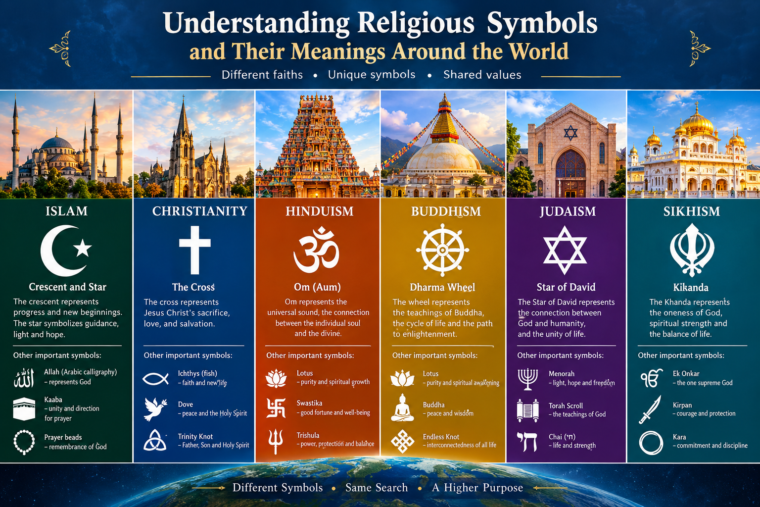
Religious symbols have been an important part of human culture for thousands of years. They can represent faith, spiritual beliefs, religious identity, important teachings, or a connection between people and their traditions.
Different religions use different symbols, and the meaning of a symbol can vary depending on its religious and cultural context. From crosses and crescents to the Om symbol and the Khanda, these symbols are often seen in places of worship, artwork, clothing, books, ceremonies, and everyday life.
What Are Religious Symbols?
A religious symbol is an image, object, sign, or design that represents an important idea within a religious tradition.
Symbols can help believers express their faith without words. They may represent God, spiritual teachings, peace, devotion, protection, religious history, or a particular community.
For many people, religious symbols are deeply meaningful and should be treated with respect.
The Cross in Christianity
The cross is one of the best-known symbols associated with Christianity.
It represents the crucifixion of Jesus Christ and is an important reminder of Christian teachings about faith, sacrifice, forgiveness, and hope. Crosses can be found in churches, homes, jewelry, artwork, and other Christian settings.
Different Christian traditions may use different styles of the cross, but its religious importance remains central to Christianity.
The Crescent and Star in Islamic Culture
The crescent and star are widely associated with Islam in modern culture, although they are not universal symbols of the religion and are not prescribed as an Islamic symbol in the Qur’an.
The crescent has historical connections with several Muslim-majority cultures and can be seen on flags, architecture, and some religious institutions.
Islam itself places strong emphasis on belief in one God, prayer, charity, fasting, and living according to religious principles.
The Om Symbol in Hinduism
Om, often written as ॐ, is an important sacred symbol in Hindu traditions.
It is connected with sacred sound, meditation, and spiritual ideas. The sound “Om” is used in various Hindu practices and is also familiar in yoga and meditation settings.
The symbol represents profound spiritual concepts and has an important place in Hindu religious and philosophical traditions.
The Dharma Wheel in Buddhism
The Dharma Wheel, or Dharmachakra, is an important Buddhist symbol.
The wheel is associated with the Buddha’s teachings, often referred to as the Dharma. Its parts can represent different aspects of Buddhist teaching and practice.
The symbol is commonly found in Buddhist temples, artwork, flags, books, and other religious settings.
The Star of David in Judaism
The Star of David is a widely recognized symbol of Judaism.
It is a six-pointed star that became strongly associated with Jewish identity and culture over time. Today, it can be found in synagogues, Jewish artwork, jewelry, community institutions, and other cultural settings.
The symbol has become an important part of Jewish identity around the world.
The Khanda in Sikhism
The Khanda is an important symbol of Sikhism.
It consists of several elements, including a double-edged sword, a circular chakkar, and two swords. Together, these elements have connections to Sikh beliefs, spiritual principles, and the balance between spiritual and worldly responsibilities.
The Khanda can be seen on Sikh flags, gurdwaras, religious materials, and other places connected with Sikh communities.
Religious Symbols in Places of Worship
Religious symbols are often visible in places of worship.
Churches may display crosses, mosques may feature Islamic artistic designs and calligraphy, Hindu temples may contain sacred images and symbols, Buddhist temples may feature Dharma Wheels and other traditional imagery, synagogues may display Jewish symbols, and gurdwaras may display Sikh symbols.
These symbols can help create a meaningful spiritual environment for worshippers.
Symbols and Religious Identity
Religious symbols can also express personal and community identity.
People may wear religious jewelry, display symbols in their homes, or use them during religious celebrations. For some believers, these symbols are a visible reminder of their values and spiritual commitments.
They can also connect individuals with a larger religious community and its history.
Why Understanding Religious Symbols Matters
Learning about religious symbols can help people understand different cultures and traditions.
A symbol that may look simple to one person can have deep spiritual meaning to another. Understanding its background can encourage respectful conversations and reduce misunderstandings between different communities.
Religious symbols also provide a way to explore how faith, history, art, and culture are connected.
Respecting Religious Symbols
Religious symbols should always be approached with cultural and religious sensitivity.
When visiting a place of worship or learning about another religion, it is helpful to understand local customs and avoid treating sacred objects or symbols disrespectfully.
Respect does not require someone to share another person’s beliefs. It simply means recognizing that religious traditions can be deeply meaningful to the people who follow them.
Final Thoughts
Religious symbols are an important part of faith and culture around the world. The cross, Om, Dharma Wheel, Star of David, Khanda, and other symbols each have their own histories and meanings.
Learning about these symbols can help us better understand the diversity of religious traditions and the ways people express faith, identity, spirituality, and community.
FaithWorld explores these traditions to encourage knowledge, understanding, and respectful appreciation of religious life around the world.
