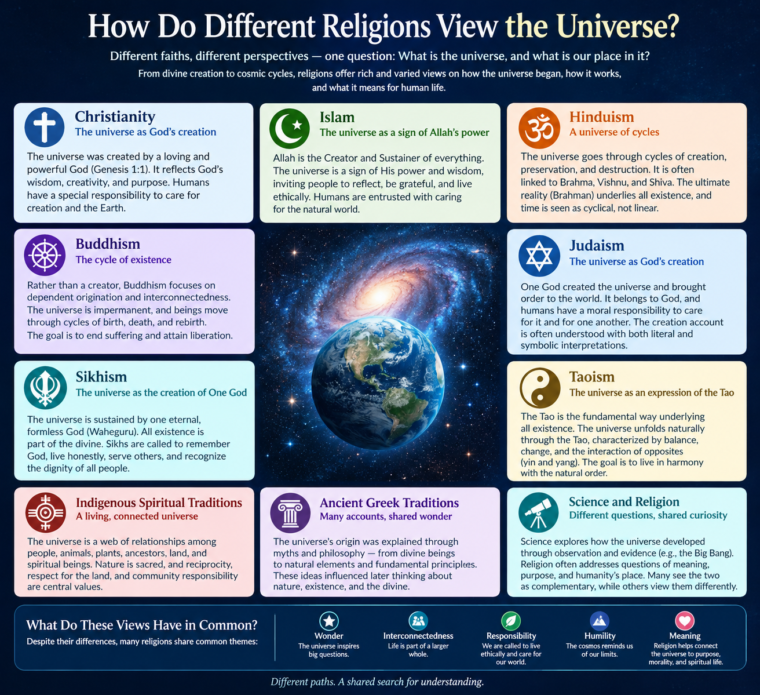
Have you ever looked up at the night sky and wondered how the universe began, why we exist, or what purpose life serves? For thousands of years, people have turned to religion to explore these profound questions. Different religious traditions offer fascinating perspectives on the origin of the universe, the nature of existence, and humanity’s place in the cosmos.
Some religions describe the universe as the creation of a supreme God, while others understand it as an ongoing cycle of creation, destruction, and renewal. Still others focus on the spiritual principles that govern existence rather than identifying a single creator. Exploring these perspectives can help us better understand the diverse ways people find meaning in the universe.
1. Christianity: The Universe as God’s Creation
In Christianity, the universe is understood as the creation of one loving and powerful God. The Bible begins with the statement, “In the beginning God created the heavens and the earth” (Genesis 1:1).
Christians generally believe that God created the universe with purpose and that all creation ultimately depends on Him. The natural world is often viewed as a reflection of God’s power, wisdom, and creativity.
Many Christians also believe that human beings have a special responsibility to care for the Earth and its living creatures. The universe is not simply a collection of physical objects; it is part of God’s creation and has spiritual significance.
2. Islam: The Universe as a Sign of Allah’s Power
In Islam, Allah is the Creator and Sustainer of the entire universe. The Quran frequently invites people to reflect on the heavens, the Earth, the stars, and the natural world as signs of Allah’s power and wisdom.
Muslims believe that the universe was created by Allah with purpose and that everything ultimately exists according to His knowledge and will.
The Quran encourages people to observe creation and think deeply about its order and complexity. From the movement of celestial bodies to the diversity of life, the universe can inspire gratitude, humility, and faith.
Islam also teaches that human beings have a responsibility to act ethically and care for the world entrusted to them.
3. Hinduism: A Universe of Creation, Preservation, and Destruction
Hinduism contains several perspectives on the origin and nature of the universe. Many Hindu traditions understand existence through recurring cycles of creation, preservation, and dissolution.
These processes are often associated with Brahma, Vishnu, and Shiva, respectively, although Hindu beliefs about these deities and their roles vary across traditions.
Some Hindu philosophies describe Brahman as the ultimate reality underlying all existence. The physical universe is understood in different ways depending on the philosophical school, including as an expression of divine reality.
Time is often viewed as cyclical rather than strictly linear. The universe passes through vast periods of creation and dissolution, followed by renewed existence.
4. Buddhism: The Universe and the Cycle of Existence
Buddhism generally does not focus on a single creator God responsible for bringing the universe into existence. Instead, many Buddhist teachings emphasize dependent origination, the principle that phenomena arise through interconnected causes and conditions.
Buddhist traditions describe cycles of existence, birth, death, and rebirth. The universe is understood as impermanent, meaning that all conditioned things change rather than remaining fixed forever.
The central concern of Buddhism is not simply discovering how the cosmos began, but understanding suffering and the path toward liberation from it.
By studying the nature of reality and practicing compassion, mindfulness, and wisdom, individuals seek to overcome ignorance and attain liberation.
5. Judaism: The Universe as God’s Creation
Judaism teaches that one God created the universe. The creation account in Genesis describes God bringing order to the world and declaring creation good.
The universe is understood as belonging to God, while human beings have moral responsibilities toward one another and the natural world.
Jewish teachings often connect belief in creation with ethical living. Caring for the Earth, pursuing justice, helping others, and living responsibly are important ways to honor the world in which human beings live.
Jewish interpretations of the creation account vary, and some understand its language symbolically rather than as a scientific description of the universe’s development.
6. Sikhism: The Universe as the Creation of One God
Sikhism teaches belief in one eternal, formless God, often referred to as Waheguru. God is understood as the source of creation and is present throughout existence.
The universe is not separate from God’s sustaining power. Sikh teachings emphasize remembering God, living honestly, serving others, and recognizing the dignity of all people.
The natural world can inspire spiritual awareness because all existence ultimately depends on the divine.
Sikhism also emphasizes humility, equality, and responsible living rather than encouraging people to become attached to material possessions or worldly status.
7. Taoism: The Universe as an Expression of the Tao
Taoism, an ancient Chinese philosophical and religious tradition, describes the Tao as the fundamental way or principle underlying the universe.
Rather than focusing on a creator who deliberately constructs the cosmos, many Taoist teachings emphasize the natural unfolding of existence through the Tao.
The universe is characterized by change, balance, and the interaction of complementary forces, commonly expressed through the concept of yin and yang.
Taoist practice encourages people to live in harmony with the natural order instead of constantly struggling to control everything around them.
8. Indigenous Spiritual Traditions: A Living, Connected Universe
Indigenous spiritual traditions around the world are diverse, and there is no single Indigenous understanding of the universe.
In many traditions, however, the universe is understood through relationships among people, animals, plants, ancestors, land, and spiritual beings.
Nature may be regarded as sacred, and particular mountains, rivers, forests, or other places can hold deep spiritual and cultural significance.
These perspectives often emphasize reciprocity, respect for the land, community responsibility, and the interconnectedness of life.
9. Ancient Greek Religious Perspectives
Ancient Greek religious traditions included multiple accounts of how the cosmos came into being.
In Hesiod’s Theogony, the origin of the universe is described through primordial realities and the emergence of divine beings. Other Greek thinkers developed philosophical explanations of the cosmos based on elements, order, or fundamental principles.
These traditions influenced later discussions about nature, existence, and the relationship between the divine and the physical world.
Ancient Greek religion was not a single unified system, and its explanations varied across communities and historical periods.
10. What Do These Religious Views Have in Common?
Although religions differ in their explanations of the universe, several recurring themes appear across many traditions.
- Wonder: The universe inspires questions about existence, purpose, and humanity’s place in the world.
- Interconnectedness: Many traditions emphasize relationships between human beings, nature, and a larger reality.
- Responsibility: Religious teachings often encourage people to live ethically and treat the natural world with respect.
- Humility: The immense scale of the cosmos can remind people that human knowledge and understanding have limits.
- Meaning: Religion can help individuals connect the universe to questions of purpose, morality, and spiritual life.
These similarities do not erase important differences. Religions disagree about creation, God, ultimate reality, and what happens after death. Understanding those differences is essential to appreciating each tradition.
11. How Does Science Relate to Religious Views of the Universe?
Science and religion often approach questions about the universe in different ways.
Modern cosmology investigates the universe through observation, mathematics, and testable explanations. The Big Bang model, for example, describes the development of the observable universe from an early hot, dense state approximately 13.8 billion years ago.
Religious traditions address additional questions about meaning, purpose, divine action, and humanity’s place in existence. Some believers see scientific discoveries as compatible with their religious beliefs, while others interpret particular scientific claims differently.
The relationship between science and religion varies among individuals and traditions. Scientific explanations of the universe’s development do not, by themselves, settle every philosophical or theological question about why anything exists.
Conclusion
Different religions offer a remarkable range of perspectives on the universe. Christianity, Islam, and Judaism emphasize creation by one God, while Hindu traditions often describe cosmic cycles and ultimate reality in diverse ways. Buddhism focuses on impermanence and dependent origination, Sikhism emphasizes one God as the source of existence, and Taoism highlights harmony with the natural order.
Indigenous traditions contribute diverse understandings of the relationships between land, life, ancestors, and the spiritual world.
These perspectives reveal that the universe is more than a subject of scientific investigation for many people. It is also a source of spiritual reflection, ethical responsibility, and profound questions about existence.
By exploring different religious views with curiosity and respect, we can gain a deeper appreciation of humanity’s enduring search to understand the cosmos and our place within it.
